This is the second part of a three-part investigation. In Part One, we traced how a fabricated "exclusive investigation" alleging a secret India-Kachin Independence Army rare earths conspiracy first appeared on Tech Bullion on November 18, 2025, and spread to four more pay-to-publish websites within eight days. The sites were linked to Pakistan- and Nepal-based SEO and PR networks. Key figures included Zeeshan Yousaf, a Pakistan-based SEO writer who bylined the original piece; Uzair Hassan, a Pakistani national connected to both Tech Bullion and Big News Network; and the Pariyar family, Nepali nationals behind at least two of the amplifying sites. None of the nine outlets contacted provided any evidence for their claims. Three deleted the story without explanation after being contacted. The story used real, documented events, including India's preliminary rare earths conversations with the KIA, as a launchpad, but all its new allegations were unsubstantiated.
_______________________________________________________________________________________________________
The KIA has been fighting for an autonomous homeland in northern Myanmar since the 1960s. Since Myanmar's 2021 military coup, it has also played a leading role in the country's wider uprising to overthrow the junta. Conflict dynamics have added new dimensions to Myanmar's rare earth mining industry, which has boomed over the past decade along the country's eastern border with China.
The industry is highly secretive, with no published permit data and mining sites tightly guarded. But import data reported by China indicates that Myanmar has in recent years surpassed China as the world's largest supplier of heavy rare earth elements used in electric vehicles, precision-guided weapons and other geostrategic technologies.
Satellite images show that the largest concentration of rare earth mining sites in Myanmar are near the town of Pangwa, in Kachin State's Chipwi township.
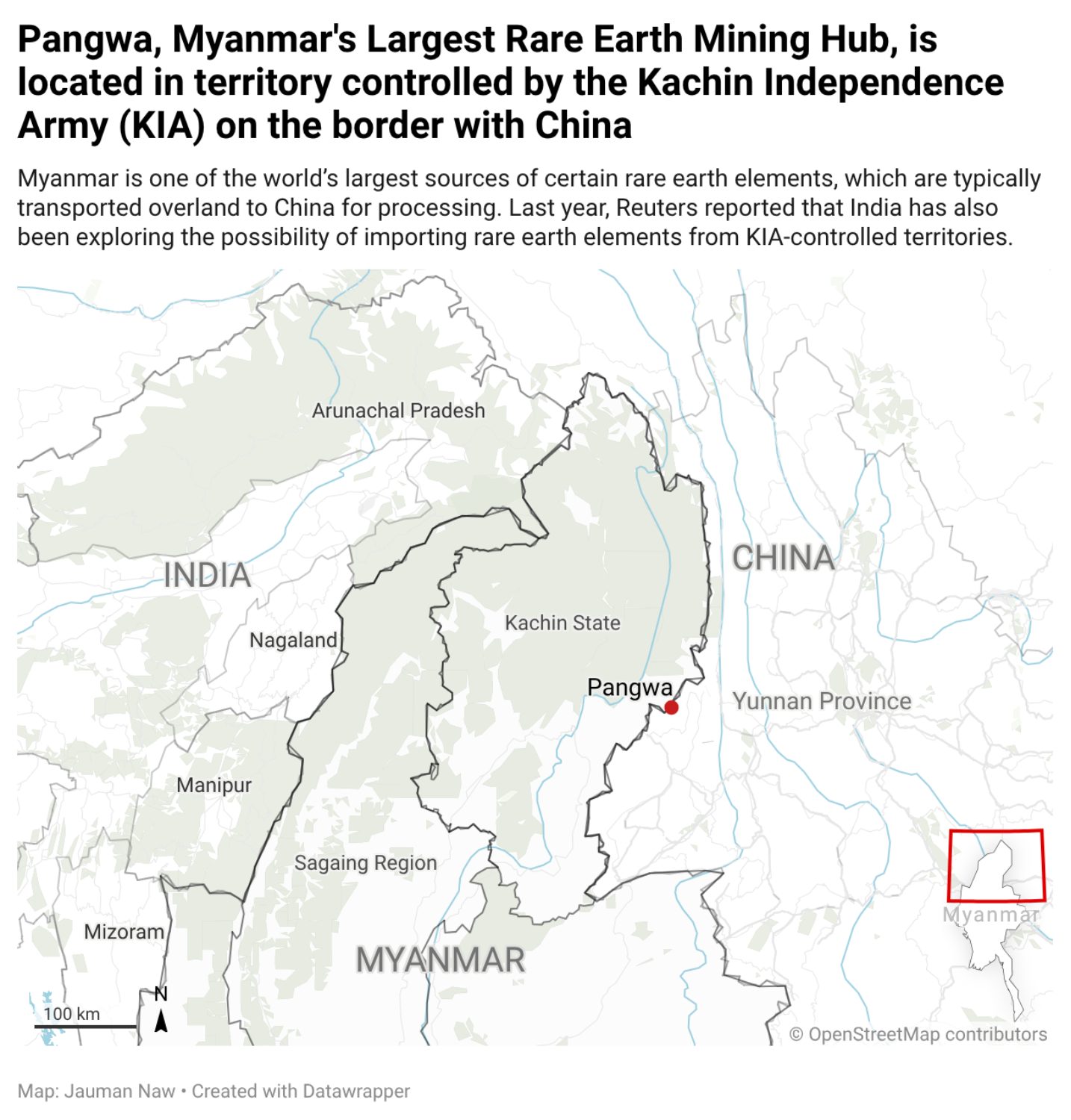
This investigation found that the Tech Bullion article, and subsequent republications, extrapolate from established information to make new claims. In October of 2024, the Kachin Independence Army seized Pangwa, giving it new leverage over Myanmar's rare earth mining industry. Reuters has since reported that in December of 2024, India's state-run rare earth mining and refining firm, IREL, sent a study team to Kachin State, and that an Indian delegation including IREL held an online meeting with people from Kachin to discuss their "interest in reopening the rare-earths sector." Reuters also reported that in July of 2025, India's Ministry of Mines asked state-owned and private firms to explore collecting and transporting rare earth samples from areas under KIA control. Another Reuters report found that in July of 2025, the administration of United States President Trump heard proposals on ways the US could access rare earths from Myanmar, including by pursuing a deal with the KIA and cooperating with India. The Tech Bullion article appears to build off of this news to introduce new, unsubstantiated claims.
The story alleged that India and the KIA are secretly partnering to construct a 365-kilometer road from India's Vijaynagar, Arunachal Pradesh, to Myanmar's Chipwi, Kachin State, in order for India to secure rare earths from Kachin, without approval from the Myanmar military. This investigation did not identify any evidence of plans or actions taken by India or the KIA to construct a road at these locations, or to collaborate in constructing a road at any location.
The story also alleged that India and the KIA are secretly partnering to build a second road from the KIA's headquarters of Laiza through Myanmar's Sagaing Region to Rihkhawdar, Chin State, with funding partially sourced from Myanmar's illegal timber smuggling networks. No evidence was found for this claim either.
In exchange for access to Kachin's rare earths, the story claimed, India is secretly providing the KIA with medical aid, logistical support and advanced weapons, transported through India's border state of Arunachal Pradesh. This investigation did not identify any evidence of any current or planned military collaboration between India and the KIA, or any evidence that India was providing any form of military or technical support to the KIA.
The story further claimed that the KIA has pledged to suppress "anti-India insurgent groups," including the National Socialist Council of Nagaland-K(YA), near Myanmar's border with India. The NSCN-K(YA) is one of several sub-factions of the National Socialist Council of Nagaland, which has for years launched cross-border attacks into Northeast India from bases in northern Myanmar. The Indian government considers the NSCN-K and its affiliates to be "unlawful" associations. This investigation did not identify any evidence to substantiate claims that the KIA had pledged to assist India in suppressing any armed groups in Myanmar.
The story alleged that the KIA has tacitly endorsed India's claims over disputed territory in Myanmar's Chin State and Kabaw Valley. In February of 2025, tensions resurfaced over longstanding disputes about control over territory in these areas. This investigation did not identify any evidence to substantiate that allegation.
The articles also attributed to an anonymous Myanmar military official the claim that the military would respond to unauthorized Indian operations in Myanmar with military action. Myanmar military publications have continued to highlight friendly ties and cooperation with India. This investigation did not identify any evidence to substantiate claims of unauthorized Indian operations in Myanmar.
Both the Indian Embassy in Myanmar and the Kachin Independence Organization, the KIA's administrative counterpart, have publicly rejected the allegations made in the Tech Bullion article and subsequent republications. For this investigation, we reached out to all nine websites that published the story with a request to substantiate the claims. None replied to a detailed list of questions or provided any evidence to substantiate their claims; three of these websites subsequently removed the story from their platforms without giving a reason. We also reached out to Neha Arora, a Reuters journalist who contributed reporting on India's preliminary rare earths engagement with the KIA. "We did not contribute to the Silicon Valley Time report and have no new reporting beyond the article we published last year," she said.
A second cluster of articles was published over five days in December, on websites with ties to Myanmar or Northeast India. All of these articles reference the Silicon Valley Times article as their source of information. While it is considered journalistic best practice to give those being investigated the opportunity to respond, none of these outlets appear to have reached out to the Indian Embassy in Myanmar or the Kachin Independence Organization for comments.
On December 13, the story was published in Burmese on the website CNI Myanmar, which ran a version on its English page four days later. CNI, which stands for Channel News Independent, regularly publishes content favorable toward the Myanmar military. An email sent to CNI bounced back; questions sent to CNI and a journalist listed on some CNI bylines, Chit Min Tun, over Facebook Messenger were delivered but went unanswered.
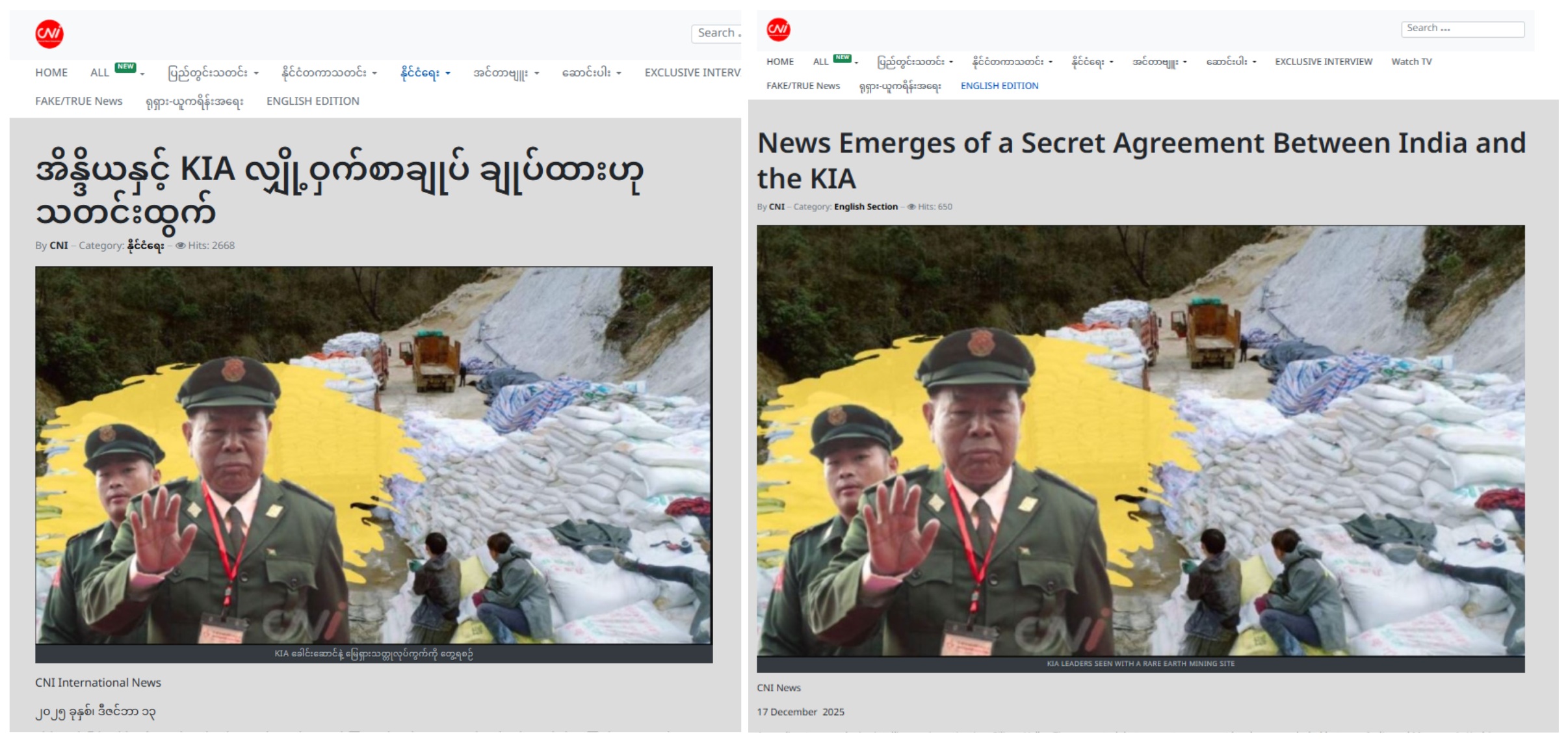
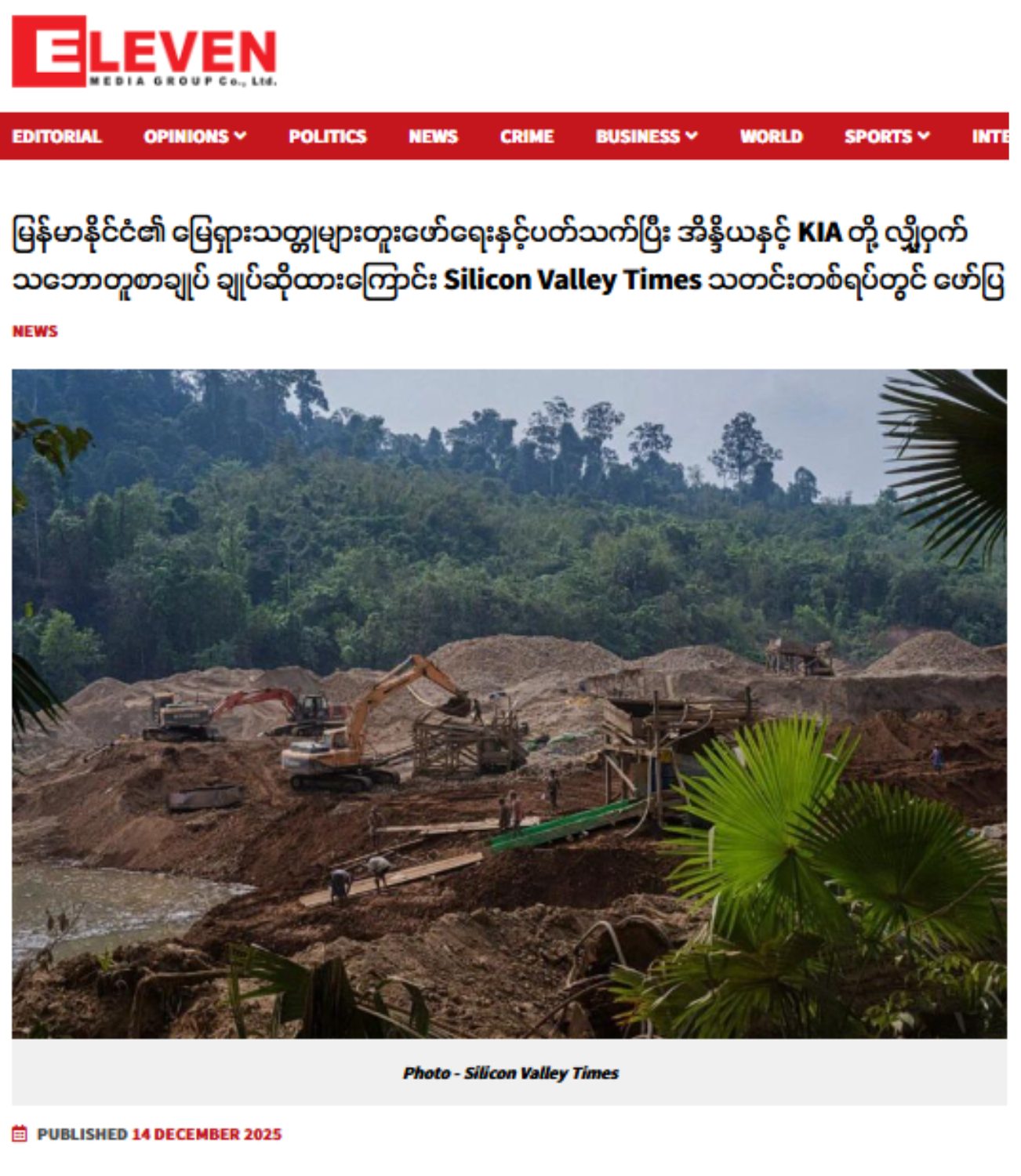
On December 14, a day after the article was published on CNI in Burmese, it was republished by Eleven Media Group, one of the largest Burmese-language news outlets. Eleven Media Group identifies as independent, but has published content favorable toward the military since the coup. An emailed list of questions sent to Eleven Media Group went unanswered.
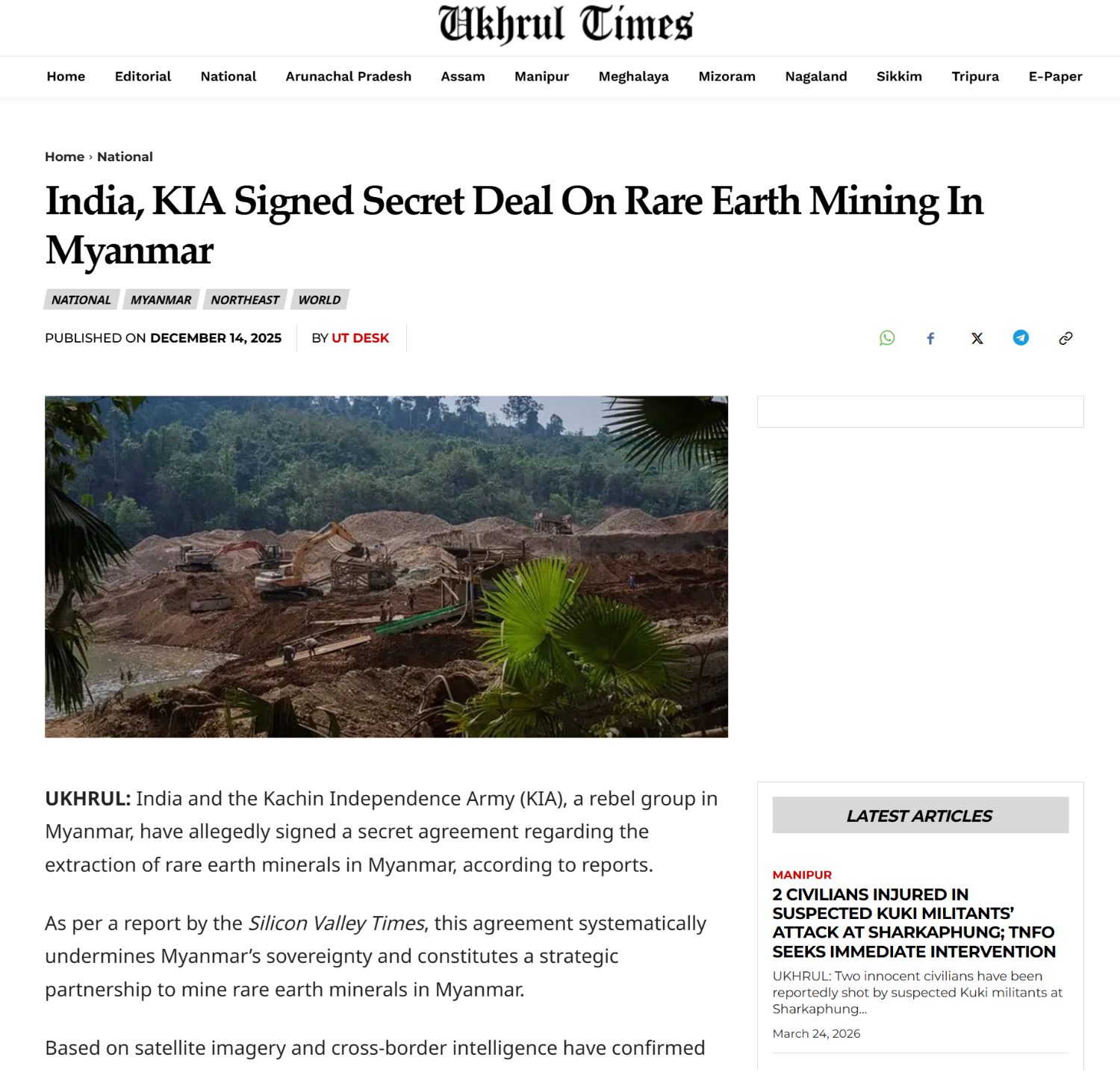
Also on December 14, a version of the story was published in English in the Ukrhul Times, an online news site originating in the Ukhrul district of Manipur, India. Unlike the previous versions of the article, this version notes that the Indian embassy in Myanmar denied the article's allegations, referencing the embassy's response to The Statesman as reported by NP News. The Ukhrul Times did not reply to an emailed list of questions.
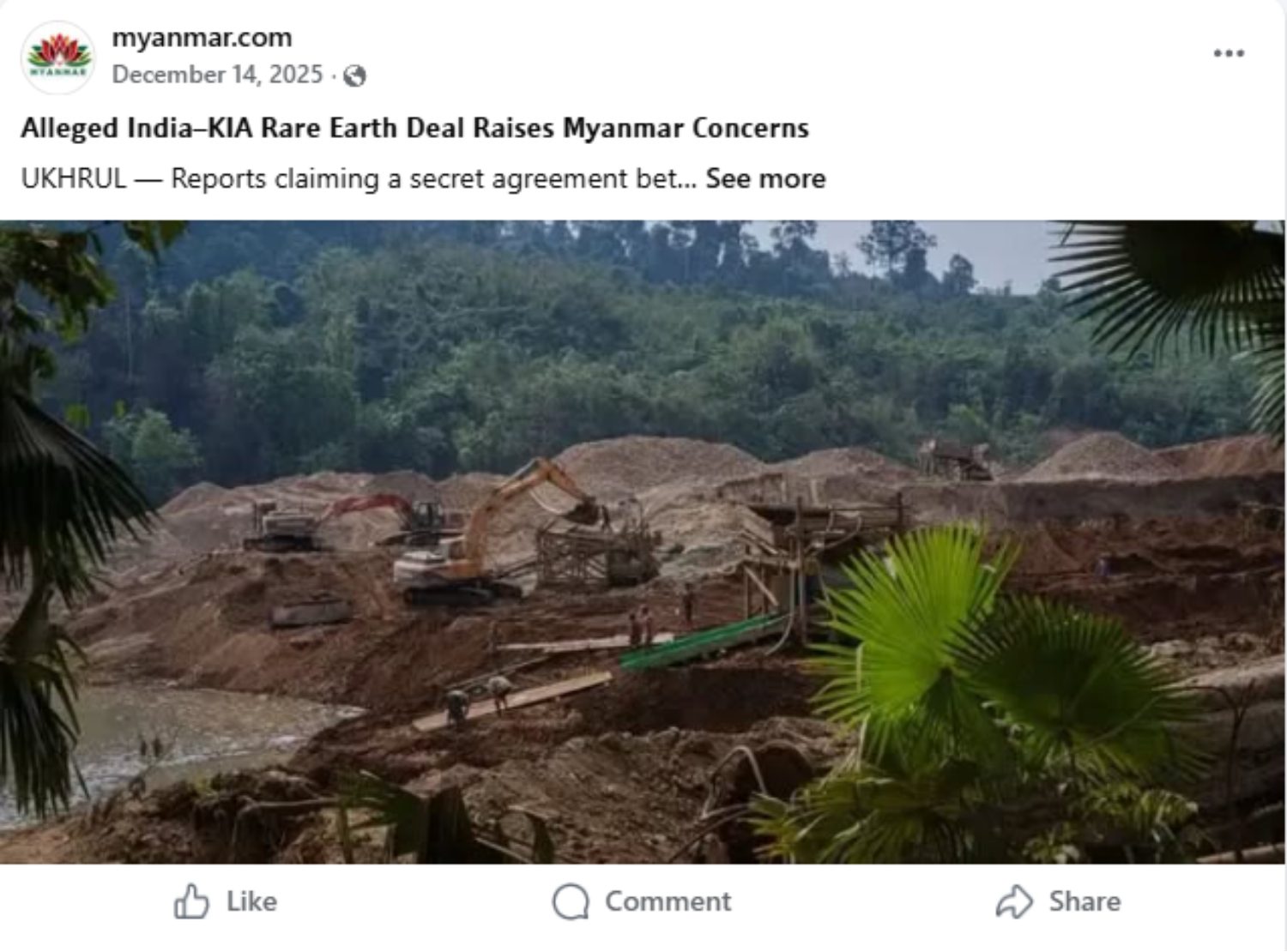
An English version of the story was also published on December 14 on myanmar.com, a self-described travel, culture and business website. The website's news tab has since been cleared, but its Facebook page still displays the article. It shows a dateline of Ukhrul, indicating that this version may have been republished from the Ukhrul Times website. Facebook analytics for the myanmar.com page show an address in Sherman, Texas and a contact email for a Thomas Winn. Thomas Winn did not reply to our questions emailed to him.
Coming in Part Three: Beginning two weeks after the story's first appearance, it was shared across X and Facebook in four coordinated waves, overwhelmingly by accounts originating in Pakistan. We examine who those accounts are, how the posts were coordinated, and what the amplification pattern reveals about who may be behind the campaign — including a previously unreported overlap between the publishing infrastructure used in this story and that associated with Spamouflage, a pro-China influence operation. _______________________________________________________________________________________________________
Emily Fishbein is a freelance journalist and fellow with the Pulitzer Center’s Rainforest Investigations Network. Jauman Naw is a freelance journalist from Myanmar.




 Hello, my name is Ankit Sahu. I'm a 25 year old self-employed Pirate from the Chhindwara.


