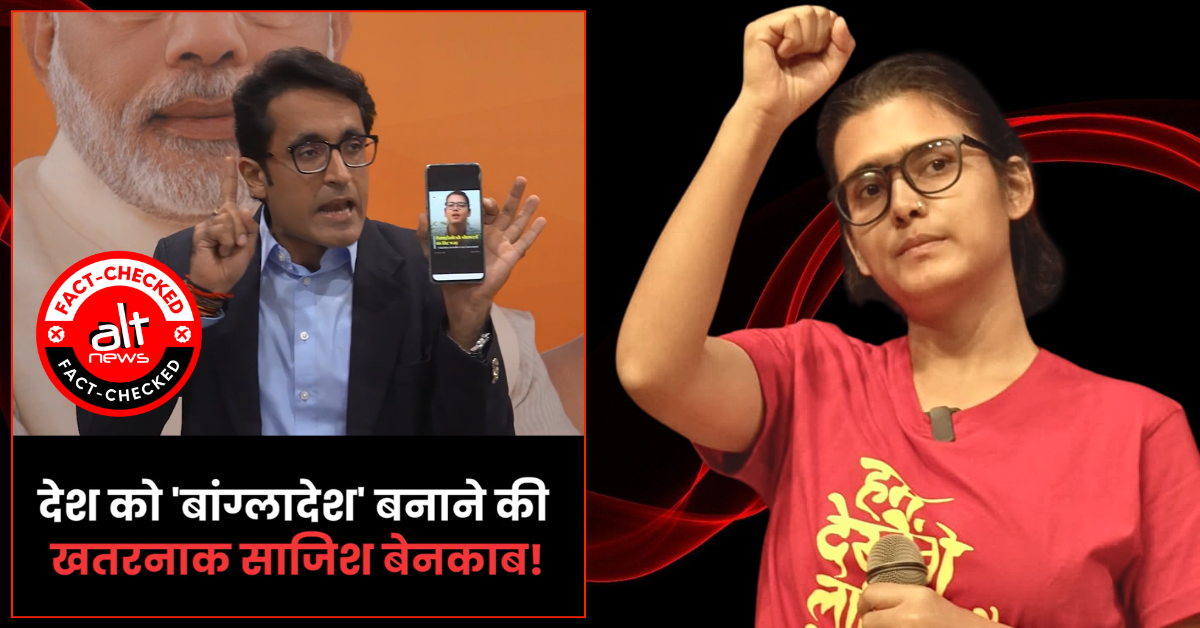
On October 15, 2026, Bharatiya Janata Party (BJP) national spokesperson Pradeep Bhandari, in a press conference, alleged that All India Students’ Association (AISA) president Neha Bora had expressed a desire to replicate Bangladesh’s Gen Z uprising in India, invoking an anarchic movement.
On the same day, the BJP’s official X account shared a video featuring Bhandari’s remarks alongside a brief excerpt from Bora’s speech. In the clip, she says, “The Gen Z protests that we are witnessing throughout this country first originated in Bangladesh. Congratulations to you for showing us the way and extending solidarity to the young people of this country.”
Right-wing commentators and social media influencers, including Abhijit Iyer-Mitra, MeghUpdates and Jaipur Dialogues, amplified similar claims -- that Neha Bora wanted a "Bangladesh like situation in India" or "violent and illegal overthrow of the gobvernment with the accompanying slaughter of Hindus".
This slideshow requires JavaScript.
In a bulletin on Republic, the channel's editor-in-chief Arnab Goswami claimed Neha was "advocating for a Bangladesh model to be implemented in India.”
In July and August 2024, Bangladesh witnessed a mass uprising that began with student protests against the government’s civil service job quota system and escalated into a nationwide movement demanding Prime Minister Sheikh Hasina’s resignation. The government’s crackdown, including the use of lethal force against protesters, left hundreds dead, while police and ruling-party supporters also came under attack. On August 5, Hasina resigned and fled the country amid the escalating protests, bringing an end to her 15-year rule. The fall of the government was followed by serious violence and attacks on minorities and other groups.
What is the Video about?
On October 13, AISA president Neha Bora sent a video message to the Socialist Students’ Front (SSF) of Bangladesh on the occasion of the organisation’s sixth central conference. The video was uploaded to SSF’s Facebook profile.
In the 1-minute-49-second message, Bora congratulated the organisation for its role in student movements in Bangladesh and expressed solidarity with its activists. She drew parallels between the struggles faced by students in Bangladesh and India, particularly over democratic and electoral rights, religious fundamentalism, the privatisation of education and the saffronisation of education.
This is what Neha said:
“The Gen Z protests that we are seeing everywhere in this country first started in Bangladesh. And congratulations to you for showing us the way and extending solidarity to the young people of this country. We know that the movement that started in Bangladesh was for democratic and voter rights; today, the movement that the young people are participating in and leading is also a movement for democratic and voting rights. We know that the fights that you fight against religious fundamentalism in your country are also fights that Gen Z and the young people of this country fight today. We understand that universities in Bangladesh, Dhaka University and Jahangirnagar University, are under increasing threat and attack; the same is the case here in India with our public institutions and central universities, where there is a massive crackdown on students' rights as well as a push towards the privatisation of education; here we are witnessing a saffronisation of education, and a crackdown on critical thinking. Similarly, in Bangladesh we are seeing an emulation where critical thought is being curbed. At the same time, political propaganda is being shoved down the throats of the young people in universities and colleges. We extend our solidarity to you. We take inspiration from you, lessons from the movements that you lead, and we hope that we, together -- you in Bangladesh and we in India -- can fight together for a better South Asia, for a better world.”
The Socialist Students’ Front is a Left-wing student organisation associated with the Socialist Party of Bangladesh (Marxist). SSF was established in 1984.
For its sixth central conference, the SSF invited representatives from Left-oriented student organisations across several South Asian countries. Among those invited were Neha Bora, president of AISA in India, and Rafi Khosa, leader of Pakistan’s Democratic Students’ Federation. Members of the national committee of SSU Sri Lanka and ANNISU (Revolutionary) Nepal were present as speakers at the conference. Bora and another AISA leader, Aditi Misra, were unable to attend the conference because of passport and visa-related issues. They sent video messages to congratulate the SSF and wish the organisation success.
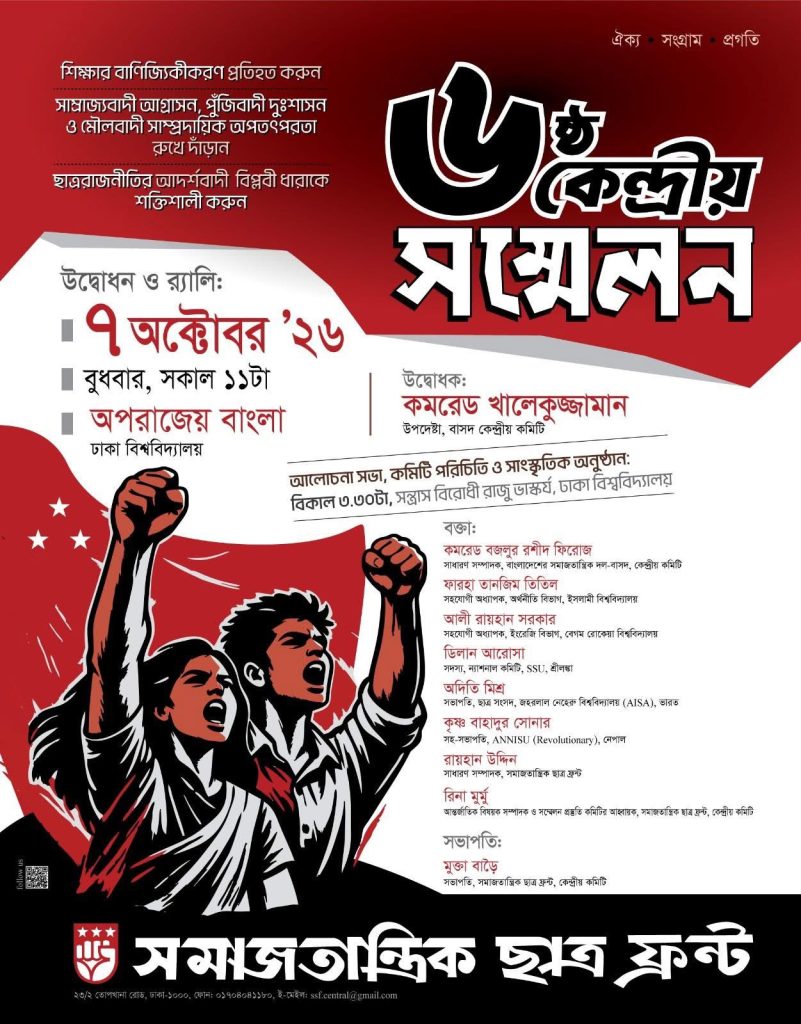
The context of the message is significant. It was addressed to the SSF and its activists on the occasion of their central conference, not to the participants of Bangladesh’s uprising as a whole. At no point in the video message does AISA leader Neha call for Bangladesh-like violence in India.
A careful reading of Neha’s words makes it clear that when she says Bangladesh’s Gen Z was “showing us the way”, she is referring to the young people who started a movement in Bangladesh for "democratic and voter rights", and against "religious fundamentalism" and government crackdown on "public institutions and central universities".
This cannot, by any reasonable interpretation, be construed as a call for a Bangladesh-like coup in India. Pro-BJP voices have omitted the context of the SSF conference and Neha’s address to its activists, misrepresenting her words as an endorsement of violence.
“Neha’s Words are being Taken out of Context”
Bazlur Rashid Firoz, secretary of the Socialist Party of Bangladesh (Marxist), told Alt News that Bora had not endorsed the violence that occurred in Bangladesh. He said, “Her words are being taken out of context”.
“She was congratulating SSF, a fellow Left-wing student organisation, for ‘showing us the way’. She goes on to explain how the SSF has stood its ground in the fight against religious fundamentalism, for restoring democratic and voting rights, and for demanding better education and employment opportunities,” he said. He added that Bora had also thanked the SSF for extending solidarity to the youth of India.
Alt News also spoke to Sucheta, a former AISA president and a central committee member of CPI(ML), who said Bora’s message had been intended specifically for the SSF and needed to be understood in that context.
She said, “This message of solidarity was addressed to the comrades of the Socialist Students’ Front (SSF). It was delivered in the context of the Gen Z movement that we witnessed in our subcontinent, particularly in Bangladesh, and the participation of secular and progressive forces in that movement.”
She added, “Neha used the term ‘religious fundamentalism’. She is speaking against such violence. Right-wing voices are trying to distort her message and misleadingly associate her speech with the violence.”
Neha Clarifies: 'Message Directed at SSF'
Following the circulation of the clip, Neha herself posted a clarification on Instagram.
In the video, she says, “Right-wing accounts removed the logo of the SSF’s central conference and other identifying graphics from the original footage to use it for propaganda against me”. She explains, “These visual elements established that the video had been recorded for the Socialist Students’ Front’s sixth national conference, addressed to its activists to express solidarity with their struggles for democracy, students’ rights, education and communal harmony.” “And the student activists in India draw inspiration from these struggles,” she added.
Neha asserts that her message was “directed at the organisation’s struggles for democratic rights, student rights, accessible education and communal harmony”. She said that her reference to “drawing inspiration from Bangladesh concerned the progressive and secular elements of its student movement, rather than the entirety of the uprising or the political forces that subsequently gained influence.”





 Hello, my name is Ankit Sahu. I'm a 25 year old self-employed Pirate from the Chhindwara.


