Amid growing concerns over a government-ordered Instagram censorship drive in India, political parties and leaders are now reporting restrictions on their posts, with Meta citing “legal requirements” but providing little information about the basis for the action. Content linked to the Cockroach Janta Party protests, political parties and creators has all been caught up in the restrictions.
Over the past few days, several social media posts and accounts have been geo-blocked in India. On Instagram, users’ posts are either removed citing legal requirements or restricted from being viewed in India. Several opposition organisations and leaders have also faced such restrictions, with their posts suddenly being taken down.
ALSO READ: Government orders trigger sweeping Instagram censorship days after CJP protest
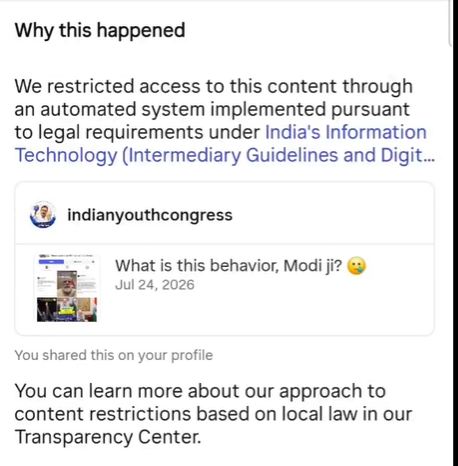
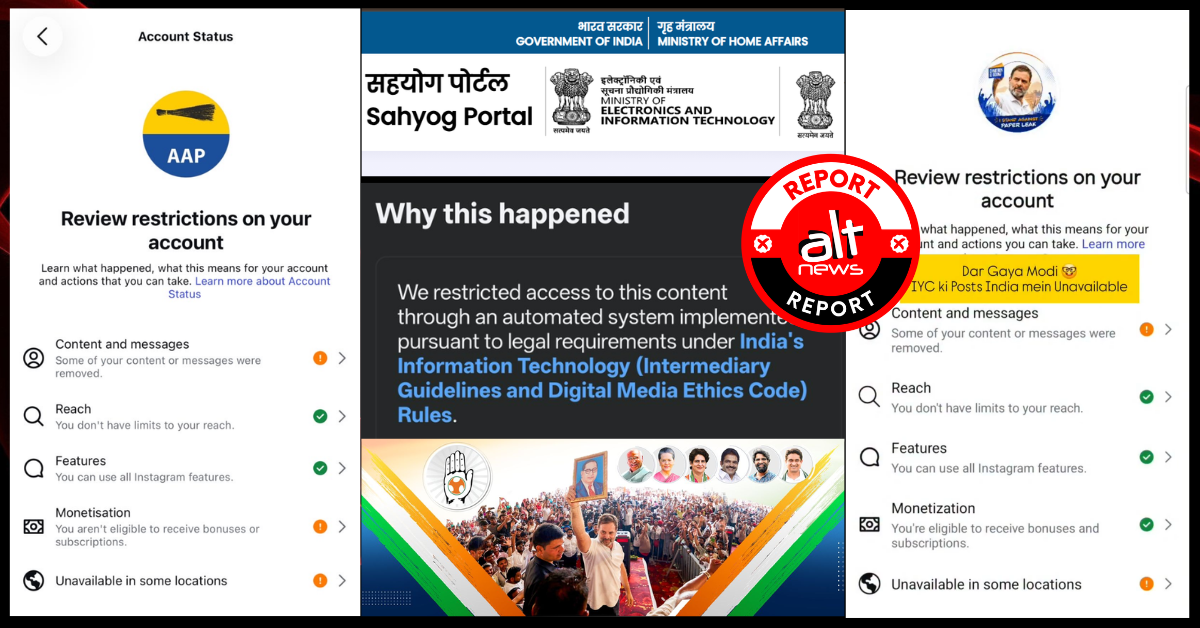
On August 6, the Aam Aadmi Party, and on August 7, the Congress party’s youth wing, the Indian Youth Congress, posted on social media to say that their Instagram posts were being repeatedly removed by Meta.
Clicking on a removed post shows a notice stating that it has been restricted by Meta’s automated systems in India, in accordance with legal requirements under India’s Information Technology (Intermediary Guidelines and Digital Media Ethics Code) Rules.
Opposition Leaders’ Posts Restricted Earlier as well
This is not the first time that posts by political entities have been restricted under these rules. Earlier, posts by Congress and TVK leaders related to Tamil Nadu chief minister C Joseph Vijay had also been removed from Instagram and Facebook, citing the same provisions.
On May 11, Goa Congress president Girish Chodankar posted on X, asking whether Prime Minister Modi was so afraid of a Congress-TVK alliance that even a video of the chief minister’s swearing-in ceremony was being blocked. Similarly, TVK leader Aravind shared a screenshot on social media showing that his Facebook post related to Tamil Nadu chief minister Vijay had been removed.
Around the same time, Meta blocked a reel featuring Rahul Gandhi and C Joseph Vijay, citing the Information Technology (Intermediary Guidelines and Digital Media Ethics Code) Rules. Following widespread criticism, Meta restored the reel.
The Union ministry of electronics and information technology said at the time that the action was the result of an internal error by Meta and had nothing to do with the ministry.
More recently, Meta itself restricted a video of Prime Minister Narendra Modi addressing students for a few hours. Meta later apologised, calling it a technical glitch. However, the incident too lacked transparency, as Meta did not publicly explain the nature of the technical glitch that had led to the restriction.
What is the Legal Provision?
The legal framework behind these restrictions is Section 79(3)(b) of India’s Information Technology Act. The provision was originally intended to determine when platforms could lose their “safe harbour” protection, or immunity from liability.
Put simply, if online platforms and social media intermediaries fail to expeditiously remove material flagged by the government after receiving notice, they may lose their legal immunity for third-party user content. This could make the social media intermediary directly liable for the material.
However, digital rights activists argue that the government is using this provision as the legal basis for a content-blocking mechanism while bypassing Section 69A, which involves greater procedural safeguards and requires written and reasoned orders.
Lack of Transparency
A serious flaw in this process is the lack of transparency. When the government sends a request flagging a post, users are not told who made the complaint or on what basis the order was issued. Instead, they see a generic notice stating that the content has been restricted in accordance with legal requirements.
Users are neither provided a copy of the order nor a case number. They are also not told which official or authority sent the takedown request.
ALSO READ: Content creators decry Instagram censorship, call restrictions a ‘digital emergency’
An even bigger problem is that ordinary users have no concrete and reliable mechanism to challenge such action. Digital rights organisations such as SFLC and IFF have been assisting some users, but the large-scale removal of posts has exposed the absence of an effective redressal mechanism.
At its core, the mechanism is unbalanced. Content is removed first, without users being given a clear reason or an opportunity to be heard. The entire burden of seeking an explanation or having the post restored is then placed on the user.
According to a recent report by The Indian Express, the government issued around 195,000 blocking orders between March and July 2026. Of these, nearly 100,000 were sent to Instagram and around 80,000 to Facebook. In addition, around 15,000 blocking orders were sent to YouTube.
A senior government official told The Indian Express that a significant share of the blocking orders -- particularly those involving Instagram -- were issued during a period when protests were gathering momentum.
The report also stated that Meta has integrated its API (Application Programming Interface) with the Sahyog portal. As a result, content marked on the system under government directions can be removed from Meta’s platforms automatically, without separate human review by the company. This automation leaves Meta with no meaningful opportunity to independently review or object to the directions before acting on them.
On August 20, the Press Information Bureau (PIB), the government’s nodal agency, shared details about the matter. It said that the Sahyog portal’s API was integrated in 2025 at the request of Meta, Facebook and Instagram’s parent company. This enables state governments and central ministries to notify IT intermediaries about allegedly unlawful content.
According to the PIB, around 298,000 URLs were sent for takedown between March and July 2026. Of these, 244,000 URLs, or 82%, were sent by state governments. This included 51,000 URLs sent by the Indian Cyber Crime Coordination Centre (I4C) in connection with cyber, infrastructure and stock-investment scams.
How does Meta’s ‘Automated System’ Actually Work?
The most confusing and opaque aspect of this entire process is Meta’s “automated system”. Notices on restricted posts state that Meta acted under an automated system, but users are not told what criteria this system uses.
Does it automatically restrict content flagged through the Sahyog portal? Or does it operate on the basis of certain keywords, images, non-compliance with AI-labelling requirements, or other factors? There is little transparency around these questions.
During the recent students' protests in Delhi against alleged irregularities in NEET-UG, reels posted by journalists, media outlets and student activists showing police action were also restricted. Posts by creators producing content related to the CJP protests were subsequently restricted as well. Alt News has published detailed reports on both instances.
More recently, an Alt News post that mentioned “Burhan Wani” was repeatedly removed by Instagram. In another instance, an Alt News fact-check was restricted for using the word “Khalistani”. we later discovered that searches on Instagram with 'Burhan Wani' or 'Monu Manesar' do not yield any result. We wrote to Meta asking whether there is a list of words that are not allowed on the platform or whether there is a government order to that effect, but we are yet to receive a response.
ALSO READ: Instagram censorship puzzle: Alt News post survives only after ‘Burhan Wani’ is removed





 Hello, my name is Ankit Sahu. I'm a 25 year old self-employed Pirate from the Chhindwara.


