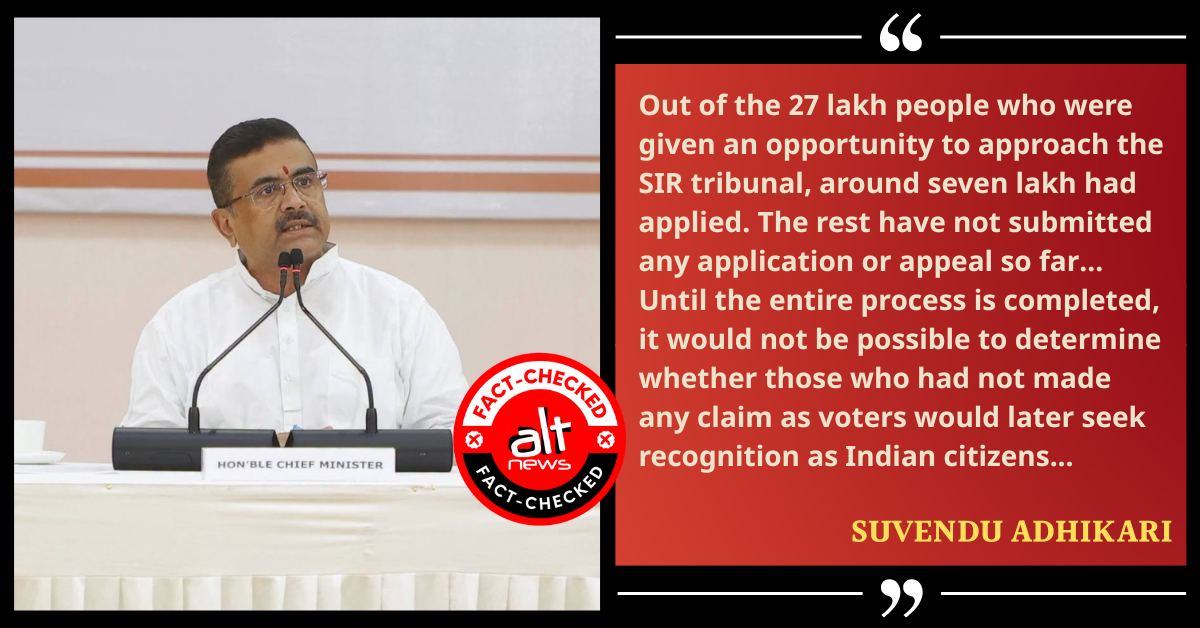
On August 1, 2026, West Bengal chief minister Suvendu Adhikari claimed that of the 27 lakh people whose names were deleted from the voter list after adjudication due to ‘logical discrepancy’, only seven lakh had filed appeals before the court-appointed appellate tribunals seeking inclusion in the electoral rolls.
Speaking at the launch of the Census self-enumeration exercise in Kolkata, he said, “Out of the 27 lakh people who were given an opportunity to approach the SIR tribunal, around seven lakh had applied. The rest have not submitted any application or appeal so far.”
The figure was reported by multiple media outlets which quoted the chief minister (1, 2, 3). Adhikari went on to link the failure to appeal with questions of citizenship, and citizenship with access to welfare, saying, “Until the entire process was completed, it would not be possible to determine whether those who had not made any claim as voters would later seek recognition as Indian citizens.” He added, “If someone is not a citizen of the country, they will not get benefits of any social scheme.”
Five days later, The Telegraph published the same seven-lakh figure, this time attributing it to an unnamed senior official of the West Bengal government. According to the report, the official said, “It has been found that only about 7 lakh of the 27 lakh voters excluded by the adjudicators for ‘logical discrepancies’ have appealed before the tribunals.” The official said the figure had emerged from a compilation of reports from various districts, and that the state authorities had no idea why the remaining 20 lakh had not appealed before the tribunals.
The Figure was Unverifiable at that Time
In August, the seven-lakh claim could not be independently verified against any official source because the Election Commission’s own disclosure did not provide a separate breakdown of appeals filed against the exclusion of voters. An RTI reply that disclosed the total number of appeals carried a footnote clarifying that the figure included both appeals against the inclusion of names in the electoral roll and appeals against exclusions.
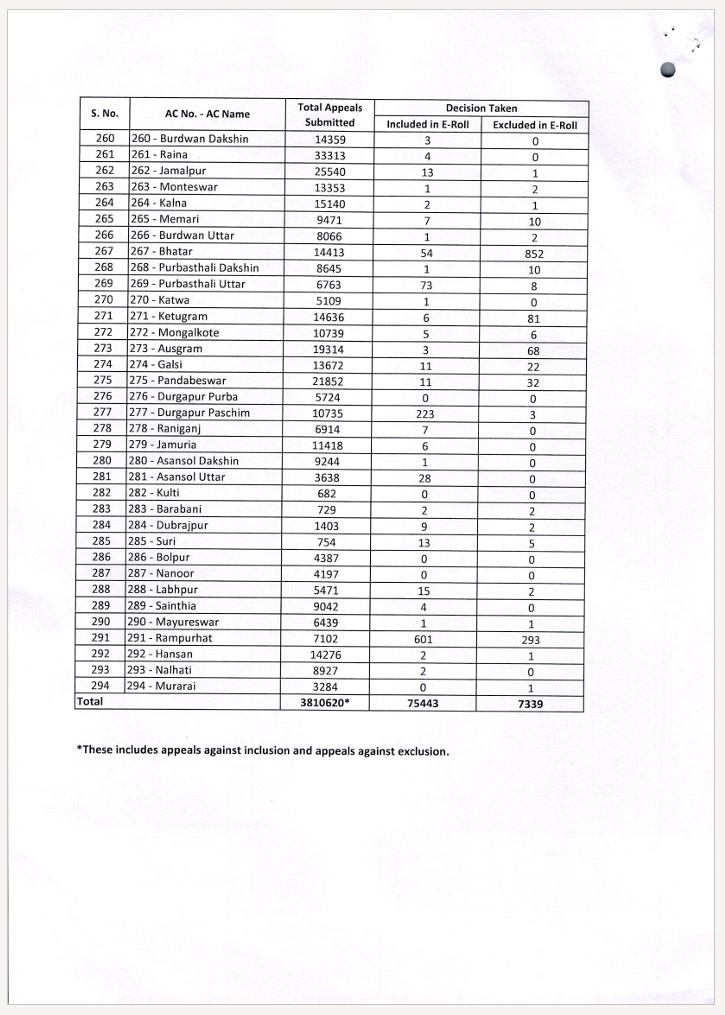
The footnote to the Appellate Tribunal Appeal Report as on 07.08.2026: "*These includes appeals against inclusion and appeals against exclusion." Source: RTI Memo No. 8551-Home (Elec) dated 17.08.2026, final page.
The RTI was obtained by Isha Khan Choudhury, Congress MP from Dakshin Malda in West Bengal, and placed before the Supreme Court on August 24, 2026, during the hearing of a petition filed by Prasenjit Bose of the Congress and Derek O’Brien of the Trinamool Congress against the Election Commission of India.
During the hearing, Justice Joymalya Bagchi observed that the break-up of the appeals mattered since “it was exclusion which was causing an immediate violation of a person’s rights.” The bench consequently directed the ECI to provide a separate account of the appeals, specifying how many were pending before the tribunals and segregating appeals relating to voters who had been excluded or included, as well as cross-appeals.
The ECI submitted this segregation on September 16.
ECI Numbers Refute Adhikari's Claim
According to the latest affidavit filed by the ECI before the Supreme Court on September 16, 2026, of the more than 38.31 lakh appeals filed, over 22 lakh were filed against exclusion by voters whose names had been excluded or deleted, while more than 16 lakh were filed against inclusion.
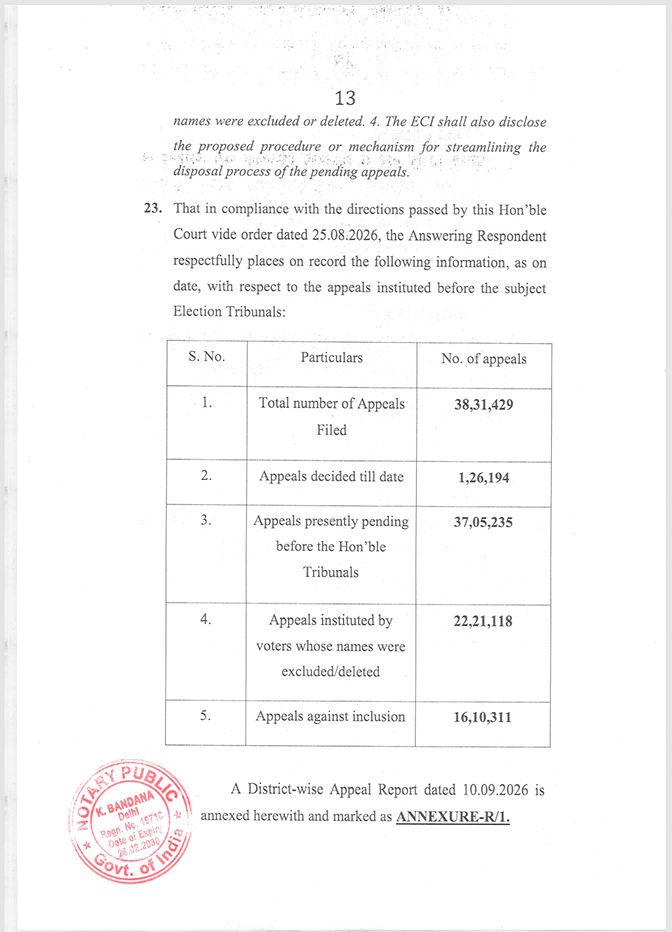
Paragraph 23 of the Election Commission's reply. Row 4: "Appeals instituted by voters whose names were excluded/deleted — 22,21,118." Source: Reply to I.A. No. 171298 of 2026 in W.P. (C) No. 737 of 2025, Derek O'Brien v. Election Commission of India, sworn by Sujeet Kumar Mishra, Secretary, ECI, filed 16 September 2026, page 13.
Of the more than 38 lakh appeals filed, only 1.26 lakh had been decided by that date. Annexure R/1 to the ECI’s affidavit provides a district-wise break-up of the total appeals submitted to the appellate tribunals and is reproduced below.
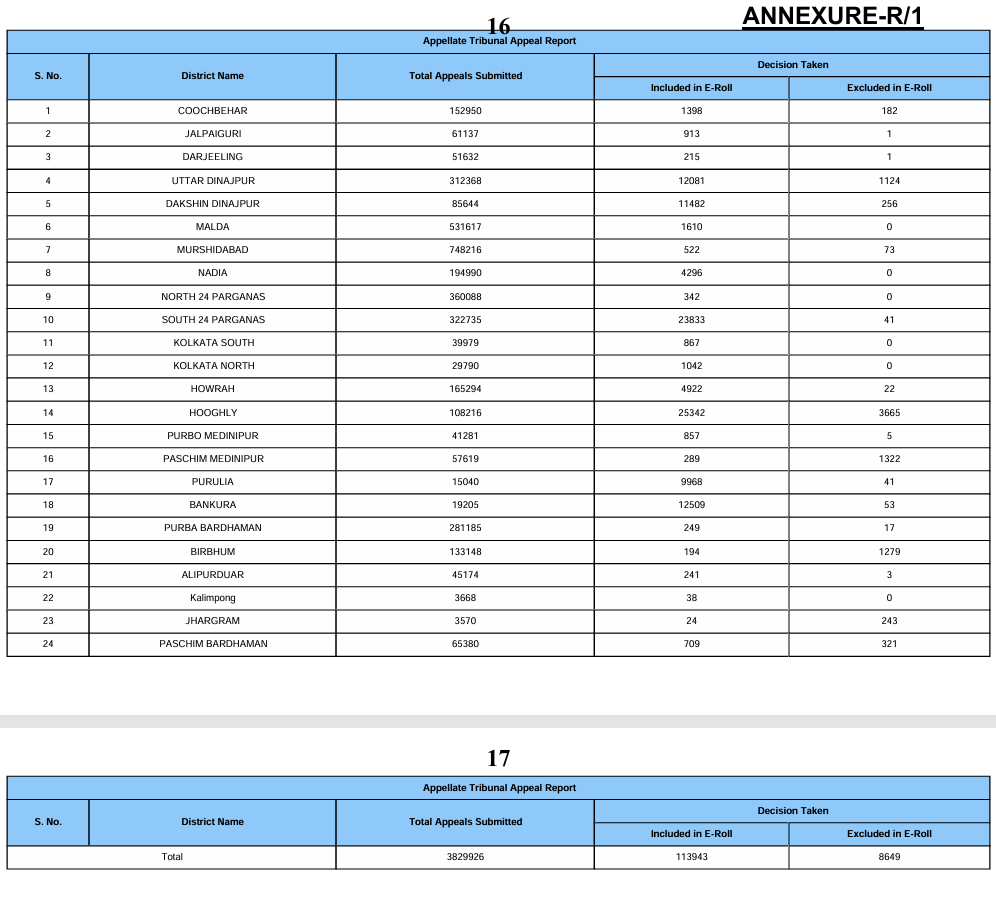
District-wise break up of Total Appeals Filed and the Decision Taken
It must be noted that the total number of appeals filed, as mentioned in the ECI’s affidavit (38,31,429), does not match the total number of appeals submitted in Annexure R/1 (38,29,926). The discrepancy is 1,503 appeals. Nevertheless, the outcome-wise data provided in the annexure shows that 8,649 appeals resulted in exclusion from the electoral roll, while 1,13,943 resulted in inclusion. In other words, nearly 93% of the appeals that had been decided resulted in the elector being included in the electoral roll.
Did the Claims Accumulate after the CM's Statement? No
One may argue that the chief minister spoke on August 1, while the Commission filed its figure in the Supreme Court on September 16, leaving enough time for appeals to have accumulated in the intervening period. The available data, however, allows this possibility to be tested directly, because appeal totals are available for both dates. On August 7, 2026, six days after the chief minister’s statement and a day after The Telegraph report, the tribunals already had 38,10,620 appeals, according to an RTI response from the ECI to Isha Khan Choudhury, Congress MP for Dakshin Malda. By September 10, 2026, the figure stood at 38,29,926, according to the district-wise report annexed to the Commission’s affidavit. Thus, the total number of appeals increased by just 19,306 across the entire state during this period.
In the light of the latest revelations made by an Indian Express investigation, which have raised serious questions about the functioning of the Election Commission of India and chief election commissioner Gyanesh Kumar, the seven-lakh claim takes on an even greater significance.
To sum up, Suvendu Adhikari's claim on August 1 that out of some 27 lakh electors placed under adjudication and subsequently excluded from the electoral roll, only seven lakh had appealed against their exclusion is difficult to reconcile with the data that was already available at the time. The ECI has made it clear that the number is around 22 lakh. The discrepancy assumes greater significance given that Manoj Agarwal, the then chief electoral officer of West Bengal who oversaw the SIR process, is now the Bengal's chief secretary.





 Hello, my name is Ankit Sahu. I'm a 25 year old self-employed Pirate from the Chhindwara.


